Tyre Checks Before a Long Journey
A pre-trip checklist for a loaded car: pressures, tread, the spare and the locking wheel nut key, plus what to do if a tyre fails on the way.
Posted on

A long drive puts your tyres under more strain than the daily commute. The car is often heavier, with passengers and luggage, you spend hours at motorway speed, and a problem far from home is harder to sort out.
Most tyre trouble on long journeys can be spotted before you leave. This checklist takes about fifteen minutes the day before you go. For the everyday habits that keep tyres healthy all year, see our tyre maintenance tips.
Short answer: Before a long journey, check:
- pressures, cold, set to the handbook figure for a full load;
- tread depth on every tyre, at least the legal 1.6 mm, and ideally well above it;
- sidewalls for cuts, bulges, cracks and embedded objects;
- the spare tyre or sealant kit, the jack and the locking wheel nut key;
- that you know what to do, and who to call, if a tyre fails on the way.
What Tyre Pressure Should You Use for a Loaded Car?
Most cars have two sets of pressures: one for normal driving and a higher one for a full load or for sustained high speed. You will find them on the sticker inside the driver’s door frame or fuel filler flap, or in the handbook. With a car full of people and holiday luggage, a roof box or a bike rack, use the full-load figure.
- Check them cold: before you have driven more than a mile or two. Warm tyres read higher, and letting air out of a hot tyre leaves it under-inflated once it cools.
- Check after packing if you can: or at least set the pressures with the load in mind.
- Reset the TPMS if needed: some cars with indirect monitoring need resetting after you change the pressures. Our guide to the tyre pressure warning light explains how.
- Go back to normal pressures when you have unloaded, if the handbook says so.
Under-inflation is the big risk on a long, fast run. A soft tyre flexes more and builds heat, which over hours at speed can lead to failure. If you need a refresher, read how to put air in tyres.
Is Your Tread Deep Enough for the Trip?
The legal minimum for cars is 1.6 mm across the central three-quarters of the tread, around the whole tyre. But grip in heavy rain falls away as tread wears, and a long journey makes it more likely you will meet bad weather somewhere along the route. If a tyre is getting close to the limit, replacing it before you go is better than worrying about it on the motorway.
Check each tyre in several places, inside and outside edges included. The tread wear indicators, small raised bars in the main grooves, sit at 1.6 mm. Our tread depth guide covers the law and the penalties.
Look for Damage, Bulges and Slow Leaks
Turn the steering to full lock so you can see the front tyres properly, and walk round the car. Look for:
- bulges or lumps on the sidewall, a sign of internal damage, often from a pothole; don’t start a long trip on one;
- cuts deep enough to show the cords underneath;
- nails, screws or glass in the tread;
- cracking on older tyres;
- wear on one edge only, which can point to an alignment problem.
If one tyre has needed topping up more often than the others, you may have a slow puncture. Get it looked at before you leave rather than hoping it will hold.
Check the Spare, the Kit and the Locking Wheel Nut Key
Many people only find out what their car carries when they need it. Before a long trip, open the boot floor and check:
- The spare tyre: is it there, inflated, and in good condition? A space-saver spare usually needs a higher pressure, printed on the wheel or in the handbook, and has its own speed limit.
- A sealant kit, if you have one instead: check the sealant hasn’t passed its expiry date. Our guide to tyre sealant explains its limits.
- Run-flat tyres: if your car has them, there may be no spare or kit at all. Know the speed and distance limits in your handbook.
- The locking wheel nut key: without it, nobody can remove a wheel easily. Know where it is and keep it in the car.
- The jack and wheel brace: make sure they are present, along with a torch, gloves and a high-visibility jacket.
Weather and Motorway Driving
Check the forecast for the whole route. In heavy rain, slow down and leave a bigger gap, as the Highway Code advises stopping distances can be at least doubled on wet roads. Standing water can cause aquaplaning, where the tyres ride on a film of water and the steering goes light. If that happens, ease off the accelerator gently and don’t brake or steer sharply until grip returns.
On long motorway stretches, plan breaks every couple of hours, and use stops to glance at your tyres. A tyre that looks lower than the others, or a new vibration or noise, is worth checking at the next services rather than ignoring. Watch out for debris, which is a common cause of punctures on fast roads.
What to Do If a Tyre Fails on the Way
If you feel a tyre go, hold the wheel firmly, ease off the accelerator and slow down gradually, braking gently once you are in control. Then:
- On a motorway: leave at the next exit or services if you can do so safely; if not, use the hard shoulder or an emergency area. Get everyone out on the side away from traffic and wait behind the barrier. Don’t change the wheel on the hard shoulder. Our guide to a flat tyre on the motorway covers this step by step.
- On other roads: stop somewhere safe, level and visible, with hazard lights on. Avoid driving on the flat tyre any further than you must, as that usually ruins it and can damage the wheel.
Getting Help on Your Journey
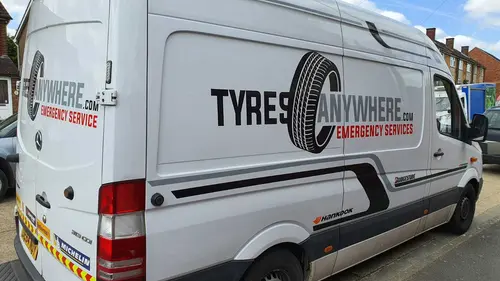
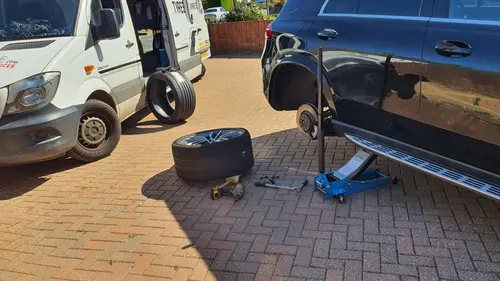
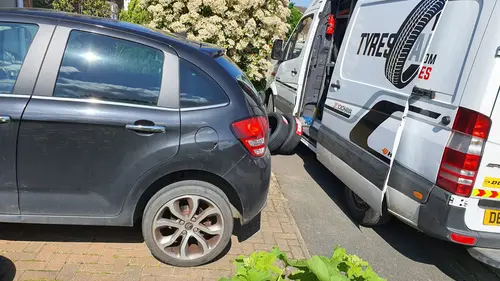
Our fitters cover England and Wales 24/7, so if a tyre lets you down away from home we can come to you at a safe location and repair or replace it. We aim to reach you within 60 minutes in most cases. See our mobile tyre fitting and breakdown recovery services.
Once you are safe, call 07989 606060, or send your location or postcode and tyre size on WhatsApp. It is worth noting your tyre size, from the sidewall, before you set off.