UK Tyre Tread Depth Law: The 1.6mm Limit Explained
What the law says, what illegal tyres can cost you, and how to check your tread at home.
Posted on
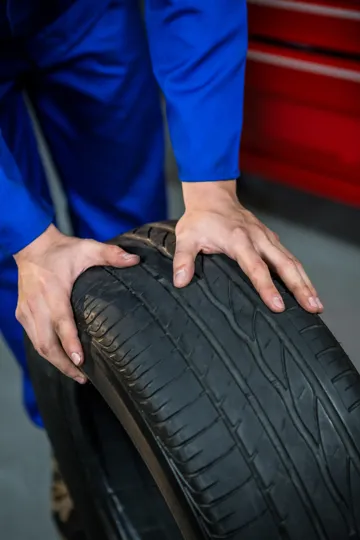
Tread is what lets a tyre grip a wet road. The grooves channel water away from the contact patch so the rubber can stay in touch with the tarmac. As the tread wears down, the grooves hold less water and grip falls away, which is why the law sets a minimum depth.
Most drivers know the number 1.6 mm, but fewer know exactly where it is measured, what the penalties are, or why many experts suggest changing tyres well before that point. This guide covers all of it.
Short answer: in the UK, the legal minimum tread depth for cars, light vans (up to 3.5 tonnes) and light trailers is 1.6 mm across the central three-quarters of the tread, around the entire circumference of the tyre. Driving on a tyre below this limit can lead to a fine of up to £2,500 and 3 penalty points for each illegal tyre. Many safety organisations recommend replacing tyres at around 3 mm, because wet braking performance drops noticeably as tread wears.
What the 1.6 mm Rule Actually Means
The rule has three parts, and a tyre has to meet all of them:
- At least 1.6 mm deep: measured in the main grooves of the tread.
- Across the central three-quarters: the outer edges (the shoulders) are not included in the measurement, but the middle 75% of the tread width must all be at or above the limit.
- Around the whole tyre: a tyre that is legal in one spot but worn below 1.6 mm somewhere else on its circumference is still illegal.
That last point matters more than people expect. Tyres do not always wear evenly. Incorrect alignment, worn suspension or the wrong pressures can wear one edge or one patch faster than the rest. If you only check one spot, you can miss a section that is already below the limit. Our guide to what can cause uneven tyre wear explains the common culprits.
Penalties for Illegal Tyres
The police can issue a fine of up to £2,500 and 3 penalty points per tyre that does not meet the legal requirements. With four illegal tyres, that could in theory mean 12 points, enough for a ban under the totting-up rules. The same rules also cover other tyre defects, such as cuts, bulges, exposed cords or a tyre that is the wrong type for the vehicle.
Worn tyres can also cause problems with insurance if you are involved in an accident, and they are checked at the MOT. A tyre below the legal limit is an MOT failure.
Why 1.6 mm Is Not a Target
The legal limit is the point at which a tyre must be taken off, not the point at which it stops performing well. As tread gets shallower, the tyre clears less water, and stopping distances in the wet grow. The difference between a tyre at 3 mm and one at 1.6 mm can be significant in an emergency stop on a wet road.
For that reason, many tyre and road safety organisations recommend replacing tyres at around 3 mm, especially before winter. If you do a lot of motorway driving or live somewhere with frequent rain, earlier replacement is a sensible choice.
| Tread depth | What it means |
|---|---|
| Around 7–8 mm | Typical for a new car tyre (varies by tyre). |
| 4 mm and above | Plenty of tread. Keep checking regularly. |
| Around 3 mm | Widely recommended point to start planning replacement. |
| 2 mm | Wet grip is reduced. Replace soon. |
| 1.6 mm | Legal minimum. Replace now. |
How to Check Your Tread Depth
You do not need special equipment to get a good idea of how much tread you have, though a gauge gives the most accurate answer. Check each tyre in at least three places across the width and at several points around it.
The 20p Test
Put a 20p coin into the main tread groove, with the Queen’s or King’s head facing you. If the outer band around the edge of the coin is hidden by the tread, you probably have more than about 3 mm. If you can see the outer band, the tread may be getting close to, or below, 3 mm, and you should measure it properly with a gauge. The 20p test is a quick guide, not a precise measurement, and it does not tell you whether you are above 1.6 mm.
Tread Wear Indicators
Most tyres have small raised bars moulded into the bottom of the main grooves, called tread wear indicators. They sit at 1.6 mm. When the surface of the tread is level with these bars, the tyre has reached the legal limit. The position of the bars is often marked on the shoulder of the tyre with a small triangle or the letters TWI.
A Tread Depth Gauge
An inexpensive tread depth gauge, available from motor factors and online, gives an exact reading in millimetres. Push the probe into a main groove, press the body flat against the tread, and read the scale. This is the most reliable way to check how close you are to the limit.
Other Signs a Tyre Needs Replacing
Tread depth is only one part of the picture. A tyre with plenty of tread can still be unsafe if it has a bulge in the sidewall, deep cracking, a cut that exposes the cords, or damage from being driven on while flat. Age matters too, as rubber hardens over time. Our list of the top 10 signs your tyre needs replacing covers these in more detail.
If you drive a van, the same 1.6 mm limit applies to vans up to 3.5 tonnes, but working vans often wear their tyres much faster. See van tyres explained for tips on getting the most from them.
Tips to Make Your Tread Last Longer
- Keep pressures correct: both under- and over-inflation cause uneven wear. Our guide on how to put air in tyres explains how.
- Get the alignment checked if the steering pulls or one edge is wearing faster.
- Drive smoothly: hard acceleration, braking and fast cornering all wear tread more quickly.
- Check tyres monthly and before long journeys.
Need New Tyres?
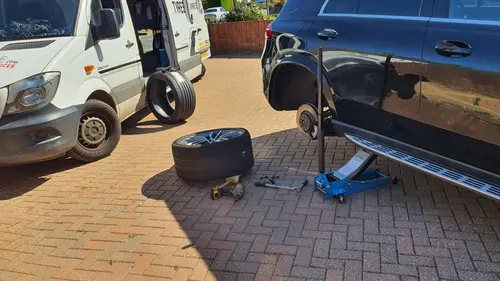
If your tyres are close to the limit, you do not need to take time out to visit a garage. Our mobile tyre fitting service comes to your home, workplace or the roadside, 24/7 across England and Wales, with free wheel balancing and old tyre disposal. You can browse the tyre brands we fit, check how our prices work, or call us on 07989 606060.