Should You Replace Tyres in Pairs?
When one new tyre is fine, when you need two or four, and which axle the new tyres should go on.
Posted on
A puncture that can’t be repaired, or a sidewall damaged by a kerb, often leaves you needing just one new tyre. The question then is whether to replace that tyre on its own, change the pair on that axle, or do all four.
There is no single rule for every car. The answer depends on how worn your other tyres are, whether the car is two-wheel or four-wheel drive, and what the vehicle manufacturer says.
Short answer: Usually, yes, at least on the same axle.
- The two tyres on an axle should be the same size and construction, and ideally the same make, model and similar tread depth;
- a single new tyre is fine if the other tyre on that axle is nearly new as well;
- when you replace only one pair, tyre makers generally advise fitting the newer tyres on the rear axle, unless your car’s handbook says otherwise;
- on many four-wheel-drive and all-wheel-drive cars, the manufacturer sets a limit on tread differences, and some require all four to be replaced together.
Why Tyres on the Same Axle Should Match
The two tyres on an axle share the job of steering, braking and holding the car through a bend. If one has much deeper tread, a different rubber compound or a different tread pattern from the other, they can grip differently, particularly on wet roads. You might notice the car pulling to one side under heavy braking, or behaving less predictably in an emergency.
A big difference in tread depth also means a small difference in rolling diameter, because a new tyre is slightly taller than a worn one. On most cars this is minor, but it is one reason why matching pairs is the safer habit.
When Is It OK to Replace Just One Tyre?
If your tyres are fairly new and the tyre on the other side of the axle still has plenty of tread, replacing only the damaged one is usually fine, provided you fit the same size, load index and speed rating, and ideally the same make and model. There is no legal maximum difference between two tyres on a car axle, so your fitter will measure both tyres and look at their condition before advising.
If the remaining tyre is already well worn, it makes more sense to replace both. You will be buying another tyre soon anyway, and the car will handle more evenly in the meantime. Before you decide, check how much life is left using our guide to the UK tread depth law.
Should New Tyres Go on the Front or the Back?
Many drivers assume the new tyres belong on the front, especially on a front-wheel-drive car, because the front tyres steer and usually wear faster. Major tyre manufacturers, including Michelin and Continental, generally recommend the opposite: if you replace only two tyres, fit the newer ones to the rear axle.
The reason is control on slippery roads. If the front tyres lose grip first, the car tends to run wide (understeer), which most drivers instinctively correct by easing off. If the rear tyres lose grip first, the back of the car can slide out (oversteer), which is much harder to recover from. Keeping the deeper tread at the rear reduces that risk.
There are exceptions. Some vehicle manufacturers give different advice for particular models, cars with different tyre sizes front and rear cannot swap tyres between axles, and directional or asymmetric tyres have to be fitted the right way round. Always check the handbook first, and adjust the pressures if tyres move to a different axle.
Four-Wheel Drive and AWD: Do You Need to Replace All Four?
This is where it matters most. On many four-wheel-drive and all-wheel-drive systems, all four wheels are linked through the drivetrain. If one tyre has a noticeably different rolling circumference from the others, the system can be forced to compensate constantly, which may put extra strain on the differentials, transfer case or couplings.
Vehicle manufacturers handle this differently. Some require all four tyres to be replaced together. Others allow a set maximum difference in tread depth between tyres, which varies by make and model. Tyre makers such as Michelin recommend running identical sets of four on four-wheel-drive vehicles. The safe approach is:
- check your handbook, or ask a main dealer, for the tread difference your car allows;
- measure the tread on all four tyres before deciding;
- if the difference would be over the limit, or you can’t confirm the limit, replace all four;
- keep the same make and model across the whole car where possible.
Can You Mix Tyre Brands or Tread Patterns?
Mixing brands on different axles is common and generally acceptable on two-wheel-drive cars, as long as each axle has a matching pair and all four tyres meet the size, load and speed rating in your handbook. Mixing different brands or patterns on the same axle is best avoided, because the two tyres may grip and wear differently.
Avoid combining summer tyres on one axle with winter tyres on the other, and mixing run-flat with standard tyres, unless the vehicle and tyre manufacturer say it is acceptable. If you are unsure whether a cheaper tyre will pair well with your existing ones, see our comparison of budget vs premium tyres.
What Are the Legal Rules on Mixing Tyres?
UK law requires the tyres on a vehicle to be suitable for the way it is used and compatible with the tyres on its other wheels. In practice, the key points are:
- you must not mix radial and cross-ply tyres on the same axle;
- tyres on the same axle should be the same size, and a mismatch in size or structure on one axle is a reason for MOT failure;
- every tyre must have at least 1.6 mm of tread across the central three-quarters and be free of serious cuts and bulges.
Almost all modern car tyres are radials, so the radial and cross-ply rule mainly affects classic cars and some trailers. For more on what testers look for, read our guide to tyres and the MOT.
Uneven Wear Is Worth Investigating
If one tyre has worn much faster than its partner, there is usually a reason, such as incorrect pressure, wheel alignment or a worn suspension part. Replacing the tyre without fixing the cause means the new one will wear the same way. Our article on what causes uneven tyre wear explains what to look for.
Getting a Matching Pair Fitted
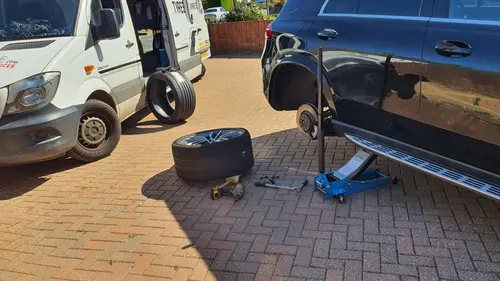
Our mobile tyre fitting fitters can check the tread on all your tyres, advise whether one, two or four are needed, and fit them at your home, workplace or the roadside. Wheel balancing and disposal of your old tyres are free with every fitting. We cover England and Wales 24/7, and we aim to reach you within 60 minutes in most cases. Call 07989 606060, or send your postcode and tyre size on WhatsApp so we can check what is available in your size.