Bulge in a Tyre Sidewall: Is It Safe to Drive?
What causes a lump on the side of a tyre, why it can’t be repaired, how it affects your MOT, and what to do right now.
Posted on
A bulge on the side of a tyre often appears a day or two after you hit a pothole or clip a kerb. The tyre still holds air and the car may drive normally, so it is tempting to carry on and deal with it later.
That would be a mistake. A sidewall bulge is one of the clearest signs that a tyre is about to fail, and it is one of the few tyre faults where the advice is the same in every case: replace it.
Short answer: No, it is not safe. A bulge means the internal cords of the tyre have broken and only the outer rubber is holding the air in.
- the tyre can burst without warning, particularly at speed or under load;
- a bulge cannot be repaired and the tyre must be replaced;
- it is an MOT failure and can make the car illegal to use on the road.
Avoid driving on it. If you must move the car, go slowly and only as far as a safe place, then fit the spare or call a fitter.
What Causes a Bulge in a Tyre?
Inside the sidewall is a layer of strong cords, called the ply or carcass, that holds the tyre’s shape against the air pressure. The rubber you can see on the outside is mainly there to protect those cords and keep the air in.
When the tyre hits something sharp-edged, such as a pothole, kerb, speed bump or debris, the sidewall can be pinched between the obstacle and the wheel rim. That impact can snap some of the cords. The air then pushes through the gap and stretches the outer rubber into a lump, sometimes straight away and sometimes over the following days.
Common causes include:
- hitting a pothole at speed, especially one with a sharp edge;
- mounting or scraping a kerb while parking or turning;
- driving over speed bumps or debris too quickly;
- running on low pressure, which lets the sidewall flex more and makes it easier to pinch.
Low-profile tyres, with short sidewalls, are more prone to impact damage because there is less rubber between the rim and the road. Keeping your tyres at the right pressure gives some protection; our article on under-inflated tyres explains why.
Is It Safe to Drive With a Bulge in Your Tyre?
No. With the cords broken, a thin layer of rubber is doing a job it was never designed to do. Heat, speed, a heavy load or another impact can make it give way, and a tyre that fails this way usually deflates suddenly rather than slowly. On a front tyre in particular, that can make the car very hard to control.
There is no safe distance or speed to give for a bulging tyre. If you have just noticed one:
- if the car is parked, leave it there and arrange a replacement tyre;
- if you are driving, slow down and pull over somewhere safe as soon as you can, away from traffic;
- fit the spare if you have one and can do it safely, then drive gently to get the damaged tyre replaced;
- on a motorway, never change a wheel on the hard shoulder; leave at the next exit or services if you can do so safely, otherwise follow our guide to a flat tyre on the motorway.
Can a Sidewall Bulge Be Repaired?
No. The British Standard for tyre repairs, BS AU 159, only allows repairs within the central three-quarters of the tread. The sidewall flexes constantly, and once its internal structure is damaged there is no repair that restores it. Patches, sealants and plugs do nothing to replace broken cords.
For the same reason, a tyre with a bulge should not be sold as a part-worn tyre. If you see one on a second-hand tyre, walk away. Our guide on how to check if a tyre is repairable explains which other types of damage rule out a repair.
Will a Tyre Bulge Fail the MOT?
Yes. MOT testers are instructed to fail a tyre with a lump or bulge caused by separation or partial failure of its structure. Exposed ply or cord is also a failure. Testers are told to distinguish real bulges from the slight ripples that are a normal result of how radial tyres are made, which brings us to an important point.
Driving on a tyre with this sort of defect is not just an MOT matter. Tyres on a vehicle used on the road must be free of serious cuts, lumps and bulges at all times, so a bulging tyre can mean penalty points and a fine if you are stopped. Our article on the UK tyre law covers the penalties.
Bulge or Normal Sidewall Ripple?
Many drivers notice small, regular dips or ripples around the sidewall, especially on a new tyre when it is inflated. These indentations come from where the layers of ply overlap during manufacture, are normal, and are not a safety issue.
| Likely a dangerous bulge | Likely a normal indentation |
|---|---|
| Sticks outwards as a lump or blister | A shallow dip or line set into the sidewall |
| One isolated spot | Several evenly spaced ripples around the tyre |
| Appeared after an impact, or grows over time | Present since the tyre was new and does not change |
| Often near a scuff or mark on the rim | No sign of any impact |
If you cannot tell which you are looking at, treat it as a bulge until someone has checked it. Also check the inner sidewall of each tyre with a torch now and then, because bulges there are easy to miss.
What to Check After Replacing the Tyre
An impact hard enough to break a tyre’s cords can also damage other parts. After replacing the tyre, watch for:
- a dent, crack or buckle in the wheel rim, which can cause slow air loss or vibration;
- the car pulling to one side or the steering wheel sitting off-centre, which suggests the alignment has been knocked out;
- new knocks or rattles from the suspension.
Our guide to wheel balancing and alignment explains the difference. If the matching tyre on the other side of the axle is much more worn than the new one, it may be worth replacing both so the car handles evenly.
Get the Tyre Replaced Where You Are
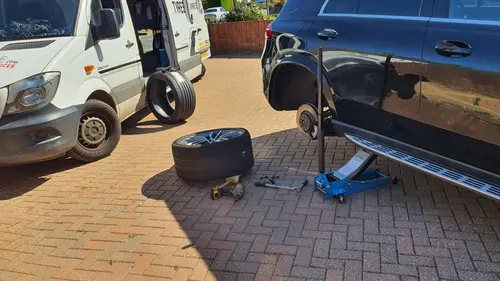
Because a bulging tyre should not be driven on, having it replaced where the car is parked is often the safest option. Our mobile tyre fitting service sends a fitter to your home, workplace or a safe roadside spot with a new tyre, and every fitting includes free balancing and old tyre disposal.
Call 07989 606060 24 hours a day, or send your postcode and tyre size on WhatsApp. We cover England and Wales and aim to reach you within 60 minutes in most cases, depending on location and traffic.