Budget vs Premium Tyres: Is It Worth Paying More?
What the tyre label tells you, where cheaper tyres fall short, and how to decide what is right for the way you drive.
Posted on
When you need new tyres, the gap between the cheapest option and a well-known premium brand in the same size can be large. Every tyre on sale in the UK has to meet the same basic legal standards, so it is fair to ask what the extra money actually buys.
The honest answer is that it depends on the tyre, the car and how you use it. Some cheaper tyres perform well, and some expensive ones are not the best choice for a small town car. This guide explains how to compare them sensibly.
Short answer: Often, yes, but not always.
- The biggest difference between budget and premium tyres usually shows up in wet braking, where independent tests regularly find longer stopping distances for the weakest budget tyres;
- premium tyres also tend to last longer and keep their grip better as they wear;
- a good mid-range tyre is often the best value for everyday driving;
- whatever you buy, compare the wet grip grade on the tyre label rather than the brand name alone.
What Do Budget, Mid-Range and Premium Actually Mean?
These are trade terms rather than official categories. Premium tyres come from the large manufacturers that spend heavily on research and testing, and they are often fitted to new cars at the factory. Mid-range tyres are frequently made by the same groups under a second brand, or by well-established manufacturers that sit just below the top tier. Budget tyres are the lowest-priced options, often from newer or less widely known makers.
All of them must meet the same legal minimum standards for sale, so a budget tyre is not unsafe simply because it is cheap. The differences are in how far above that minimum a tyre performs, and how consistently it does so across wet and dry roads, temperatures and its whole life. You can see the brands available on our tyre brands page.
How to Read the Tyre Label
New tyres sold in the UK come with a label that gives you three useful measures. It is the quickest way to compare two tyres in the same size, whatever the brand.
- Wet grip: graded from A (best) to E. This is based on a braking test on a wet surface and is the grade that matters most for safety in the UK climate.
- Rolling resistance (fuel efficiency): also graded A to E. A tyre with lower rolling resistance takes less energy to roll, which means slightly better fuel economy, or more range in an electric car.
- External noise: shown in decibels with a class. A lower figure means a quieter tyre for people outside the car, and often a calmer cabin too.
Some labels also show symbols for snow or ice performance. The label is a helpful starting point, but it doesn’t cover everything. It says nothing about dry handling, wear life or how grip changes as the tyre wears. For a fuller explanation of sidewall and label ratings, see our guide to tyre ratings.
Do Budget Tyres Take Longer to Stop in the Wet?
This is where the difference is usually clearest. Independent magazine and website tyre tests in the UK and Europe routinely include a budget tyre alongside premium and mid-range ones, and the weakest budget tyres tend to need noticeably more distance to stop on a wet road. In one 2025 test of sports car tyres by Tyre Reviews, the best tyre stopped from 100 km/h in the wet in about 40 metres, while the budget tyre in the test needed close to 70 metres.
That is an extreme example on a high-performance car, and not every budget tyre does so badly. Some score respectably, and the gap in dry conditions is usually much smaller. But wet roads are normal in Britain for much of the year, and the extra stopping distance arrives at exactly the moment you need it most. That is the main argument for paying more, or at least for choosing a tyre with a good wet grip grade.
Do Premium Tyres Last Longer?
Often they do. Premium tyres generally use more advanced rubber compounds and are designed to keep performing as the tread wears down, rather than only when new. A tyre that lasts noticeably longer can close some of the price gap over its life, especially if you cover high mileage.
Wear depends heavily on your car and how you look after it, though. Correct pressures, good wheel alignment and smooth driving make a bigger difference to tyre life than many drivers expect. And whichever tyre you choose, it must be replaced before it reaches the 1.6 mm legal limit.
Is Mid-Range a Good Compromise?
For many drivers, yes. A good mid-range tyre often shares technology with a premium sister brand from a previous generation, and can deliver solid wet grip and reasonable wear for less money. When you compare mid-range options, look for:
- a wet grip grade of A or B;
- a load index and speed rating that match or exceed what your car’s handbook specifies;
- results in recent independent tests in your size, if you can find them;
- a fresh manufacturing date, shown by the four-digit DOT code on the sidewall (week and year).
Which Type of Tyre Suits the Way You Drive?
| Your driving | What usually makes sense |
|---|---|
| High mileage, lots of motorway driving | Premium or strong mid-range: wet braking and wear life both matter |
| Powerful, heavy or performance car | Premium, or the tyre the manufacturer approves for the car |
| Family car, mixed driving | Mid-range with a good wet grip grade |
| Low mileage, mainly short trips at low speeds | A well-reviewed budget or mid-range tyre can be reasonable |
| Van carrying heavy loads | The correct C-rated tyre and load index first, then quality |
Some cars come with tyres marked for a specific manufacturer, such as a star on BMWs or MO on Mercedes models. These are developed with the car maker, and it is worth sticking with them if you can. For more on picking the right type, read how to choose the right tyres for your car.
Mixing Budget and Premium Tyres on the Same Car
If you replace only two tyres, try to fit the same make and model as the tyre on the other side of that axle. Two different tyres on one axle can grip differently, particularly in the wet, which can make the car pull under braking. Our guide on whether to replace tyres in pairs explains why matching matters and where the newer tyres should go.
Get the Right Tyre Fitted Where You Are
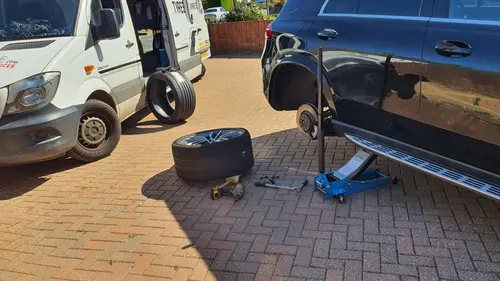
We supply premium, mid-range and budget tyres for cars, vans and light commercial vehicles, and our fitters can talk you through the options in your size before anything is fitted. Through our mobile tyre fitting service, a fitter comes to your home, workplace or roadside, with free wheel balancing and free disposal of your old tyres, and new tyres carry the manufacturer’s guarantee. Prices depend on size, brand, time and location, and there are no hidden fees. Call 07989 606060, 24 hours a day, or send your postcode and tyre size on WhatsApp.