Can You Drive on a Flat Tyre?
Why driving on a flat is a bad idea, how quickly the damage builds up, where run-flat tyres fit in, and how to get off the road safely.
Posted on
When a tyre goes flat, the temptation is to carry on and deal with it later, especially if home or the next town is only a few miles away. The car may still move, and it can feel as though a little further won’t hurt.
In reality, driving on a flat tyre is one of the quickest ways to turn a cheap problem into an expensive one, and it can make the car much harder to control. Here is what actually happens, and what to do instead.
Short answer: No, not with an ordinary tyre, except for the shortest distance needed to reach a safe place to stop.
- a flat tyre gives poor grip and steering, and braking is less predictable;
- the sidewalls are crushed between the wheel rim and the road, which ruins the tyre, often within a short distance;
- the rim itself can be bent or scraped, adding the cost of a wheel;
- a puncture that could have been repaired usually can’t be once the tyre has been run flat.
Run-flat tyres are the exception, but only within the speed and distance limits in your handbook.
What Happens When You Drive on a Flat Tyre?
An inflated tyre is held in shape by the air inside it. Take the air away and the weight of the car rests on the sidewalls and, increasingly, on the wheel rim. Every turn of the wheel folds the sidewall between the rim and the road surface.
- The sidewall breaks down: the constant flexing builds heat and grinds the rubber inside the tyre. Fitters often find rubber dust, creases or a worn ring on the inner liner of a tyre that has been driven flat. That damage can be hidden from the outside.
- The tyre can come off the rim: at low pressure the tyre bead is no longer held firmly against the wheel. In a corner it can roll off, leaving you on bare metal.
- The wheel gets damaged: alloy wheels are easily bent, cracked or gouged once the rim is close to the road, and a damaged wheel may not seal properly against a new tyre.
- Other parts can suffer: shredded rubber can flail around inside the wheel arch and damage wiring, brake components or bodywork.
Is It Dangerous?
Yes. A flat tyre has very little grip, so the car is likely to pull towards the flat side, especially under braking. Steering feels heavy or vague, and the car can become unstable when you change direction quickly. In wet weather the effect is worse. If the tyre comes off the rim or breaks up, you can lose control suddenly.
A flat at the back can be harder to notice than one at the front, because the steering may feel almost normal. Signs include a rumbling or flapping noise, a vibration through the seat, the car wandering at speed and, on cars sold new since late 2014, the tyre pressure warning light. Our guide to the tyre pressure warning light explains what it is telling you.
How Far Is Too Far?
There is no safe distance for driving on a fully flat ordinary tyre. How quickly it is ruined depends on the speed, the weight of the car, the road surface and how flat the tyre is, but damage can start within a short distance. Assume that anything more than getting yourself out of danger will cost you the tyre.
The sensible rule is this: drive only as far as you need to reach a safe place to stop, and do it slowly. That might mean crawling a short way to a lay-by, a side road or a car park rather than stopping on a bend or a narrow road where other drivers can’t see you. Your safety comes first, and a tyre is cheaper than an accident.
A tyre that is soft rather than completely flat is a different situation, but it still needs attention quickly. If it is holding some air, you may be able to inflate it to the correct pressure and drive gently to get it checked. If it keeps going down, you probably have a slow puncture.
Why a Repairable Puncture Becomes Unrepairable
Many punctures from nails and screws in the main part of the tread can be repaired to the British Standard, BS AU 159. One of the conditions, though, is that the tyre has not been damaged by running flat or badly under-inflated. That is why a fitter removes the tyre from the wheel and inspects the inside before agreeing to repair it.
So the choice you make in the first few minutes matters. Stop promptly and the hole may be fixable. Drive on to get home and you will very likely be buying a new tyre, and possibly a wheel. Our guide on how to check if your tyre is repairable covers the other conditions.
What About Run-Flat Tyres?
Run-flat tyres are designed to be driven on after losing pressure. Their reinforced sidewalls carry the car for a limited distance, so you can reach somewhere safe instead of stopping at the roadside. The figure often quoted is around 50 miles at up to 50 mph, but it varies between tyres and cars, so check your handbook for the limit that applies to you.
A few points to bear in mind:
- the limits assume careful driving, so avoid sharp braking, hard cornering and heavy loads;
- run-flats only work if your car has them; check the sidewall for markings such as RFT, ROF, SSR or ZP rather than assuming;
- a run-flat that has been driven deflated usually has to be replaced rather than repaired, as explained in can run-flat tyres be repaired?
Tyre sealant from the kit supplied with many cars is a different thing. It can seal a small hole in the tread for a short, slow trip, but it won’t help with a large cut, a sidewall puncture or a tyre that has come off the rim.
How to Get Off the Road Safely
- Don’t brake hard. Hold the steering wheel firmly, ease off the accelerator and let the car slow down, then brake gently once you are in control.
- Signal and pull over somewhere safe. Choose a spot that is level, off the carriageway if possible, and visible to other traffic. Avoid bends, brows of hills and narrow verges.
- Make yourself visible. Switch on your hazard lights. On an ordinary road you can place a warning triangle well behind the car if it is safe to do so, but never on a motorway.
- Get out on the side away from traffic. Wait somewhere safe, away from the car and the road.
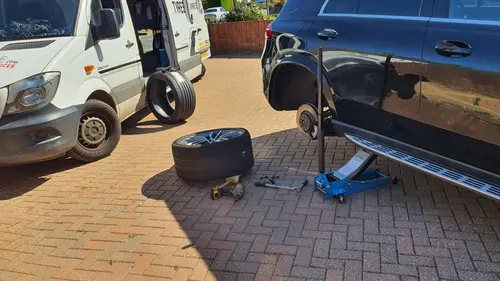
- Decide whether you can change the wheel. Only fit a spare if you are well away from moving traffic, on firm level ground, and confident doing it. On a motorway or fast dual carriageway, don’t try, and follow our advice on a flat tyre on the motorway.
If you do fit a space-saver spare, remember it is a temporary wheel with its own speed limit, usually shown on a sticker on the wheel or in the handbook.
Getting Help With a Flat Tyre
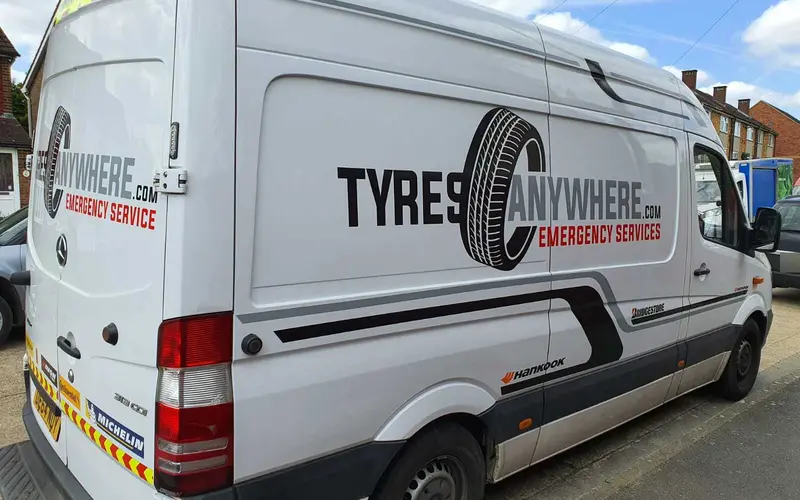
If you are stuck with a flat, our mobile fitters can come to you, 24 hours a day across England and Wales, and we aim to reach you within 60 minutes in most cases. Where the tyre is safe to fix, we carry out a mobile puncture repair; if not, we fit a new tyre on the spot through our mobile tyre fitting service, with free wheel balancing and old tyre disposal.
Once you are somewhere safe, call 07989 606060, or send your postcode and tyre size (from the sidewall, for example 205/55 R16) on WhatsApp.