Slow Puncture: Signs, Causes and What to Do
How to spot a slow puncture, what usually causes one, and how to deal with it before it becomes a flat tyre.
Posted on
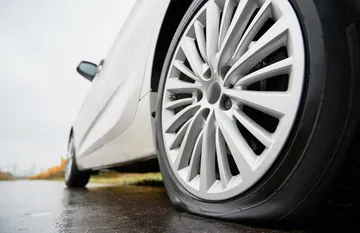
A slow puncture doesn’t announce itself the way a blowout does. The tyre loses air gradually, over hours, days or even weeks, so it is easy to top it up, forget about it and carry on. The trouble is that driving on a tyre that keeps going soft wears it unevenly, affects braking and handling, and can damage the tyre to the point where it can no longer be repaired.
Here is how to tell whether you have a slow puncture, what is most likely causing it, and what to do next.
Short answer: A slow puncture is a small leak that lets a tyre lose air gradually.
- Signs: one tyre keeps needing air, the tyre pressure warning light comes on, the car pulls to one side, or the steering feels heavier.
- Common causes: a nail or screw in the tread, a leaking valve, a poor seal between the tyre and a corroded or damaged rim, or a small cut.
- What to do: check and correct the pressure, look for the cause, and get the tyre inspected soon. Many slow punctures in the tread can be repaired if caught early.
Signs You Have a Slow Puncture
One tyre keeps losing pressure
All tyres lose a little air naturally over time, which is why pressures should be checked regularly. The tell-tale sign of a slow puncture is that one tyre drops noticeably more than the others, and keeps doing so after you top it up. If you find yourself inflating the same tyre every few days, something is letting air out.
The tyre pressure warning light
Most modern cars have a tyre pressure monitoring system (TPMS). A warning light that comes on, goes off after you add air, then returns a few days later is a classic slow puncture pattern. Some systems show the pressure of each tyre, which makes it easy to see which one is falling. Our guide to the tyre pressure warning light explains what the different warnings mean.
Changes in how the car drives
A soft tyre has more rolling resistance and a different footprint, so you may notice:
- the car drifting or pulling towards one side;
- heavier or less precise steering, especially if a front tyre is low;
- more road noise, a vague feeling through bends, or extra vibration;
- a tyre that looks visibly flatter or more bulged at the bottom than the others.
By the time a tyre looks low, it is often well below the correct pressure, so don’t rely on looks alone. Running on under-inflated tyres affects grip, braking distances and fuel use.
What Causes a Slow Puncture?
- A nail or screw in the tread: the most common cause. The object partly plugs the hole it made, so air seeps out around it rather than escaping all at once. See can a tyre with a nail or screw in it be repaired?
- A faulty valve or valve core: valves are rubber or metal and age, crack or get damaged. The small core inside can also work loose or let grit in. A missing valve cap makes this more likely.
- A leaking bead seal: the bead is the edge of the tyre that seals against the wheel rim. Corrosion on alloy wheels, kerb damage or dirt trapped during fitting can stop it sealing fully, so air escapes slowly around the rim.
- A small cut or crack: glass, stones or sharp debris can leave a cut that doesn’t go straight through but still lets air leak. Cuts in the sidewall are not repairable.
- A damaged wheel: a hard pothole strike can bend or crack a rim, which may leak without any obvious damage to the tyre itself.
It is also worth knowing that tyre pressure falls when the temperature drops. On the first cold mornings of autumn, all four tyres may read lower and the warning light may come on. If every tyre is down by a similar amount and they hold pressure once corrected, that is unlikely to be a puncture.
How to Find a Slow Puncture
Start with a careful look. Turn the steering to full lock so you can see the front tyres, and move the car a short distance to check the part of each tyre that was on the ground. Look for nail or screw heads, cuts, embedded glass and damage to the rim.
If nothing is obvious, try the soapy water test:
- Inflate the tyre to its correct pressure.
- Mix a little washing-up liquid with water in a spray bottle or bowl.
- Spray or brush it over the tread, the valve, and the edge where the tyre meets the rim.
- Watch for small bubbles forming. A steady stream of bubbles shows where air is escaping.
Do this on level ground with the handbrake on, and don’t remove anything you find in the tyre.
What to Do About It
Correct the pressure
Inflate the tyre to the pressure in your handbook or on the sticker inside the door frame or fuel filler flap. If you are not sure how, see how to put air in tyres. Check it again after a few hours to get an idea of how quickly it is losing air.
Get it looked at soon
A slow puncture rarely fixes itself and usually gets worse. The longer you drive on a tyre that keeps going soft, the greater the chance that the sidewalls are damaged from running under-inflated, which rules out a repair. Caught early, the outcome depends on the cause:
- a puncture in the central part of the tread, up to 6 mm, can usually be repaired to British Standard BS AU 159;
- a leaking valve can be replaced;
- a bead leak can often be cured by removing the tyre, cleaning the rim and resealing it, although badly corroded or damaged wheels may need refurbishing or replacing;
- sidewall or shoulder damage, or a tyre damaged by being driven while flat, means a new tyre.
Don’t drive on it if it goes flat
If the tyre deflates fully, stop somewhere safe and don’t carry on driving. Fit the spare if you have one and it is safe to do so, or call for help. Our guide on what to do if you get a flat tyre covers your options, and if it happens at speed, read flat tyre on the motorway: what to do.
Let Us Find the Leak
If you think you have a slow puncture, our fitters can come to you at home, at work or at the roadside to find the leak and carry out a mobile puncture repair where the tyre is repairable. If it isn’t, we can replace it there and then with our mobile tyre fitting service, including free wheel balancing and old tyre disposal. We cover England and Wales 24/7, with competitive prices and no hidden fees. Call 07989 606060.