Flat Tyre on the Motorway: What to Do
Where to stop, how to keep yourself and your passengers safe, and how to get moving again after a flat or blowout on a fast road.
Posted on

A flat tyre is a nuisance anywhere, but on a motorway or fast dual carriageway it is a safety problem first and a tyre problem second. Traffic is passing at high speed, sometimes only a few feet away, and the hard shoulder is one of the most dangerous places to stand.
This guide follows the Highway Code and National Highways advice. The aim is simple: get your vehicle somewhere safe, get yourself away from the traffic, and let someone with the right equipment deal with the tyre.
Short answer: If you get a flat tyre on the motorway:
- Leave at the next exit or services if you can do so safely. If not, pull onto the hard shoulder or into an emergency area.
- Switch on your hazard lights, and sidelights at night or in poor visibility.
- Get everyone out through the doors on the side away from the traffic, and wait behind the safety barrier.
- Call your breakdown provider or a roadside tyre service. Don’t try to change the wheel on the hard shoulder.
- If you are stuck in a live lane and can’t get out safely, stay in the car with your seatbelt on, hazards on, and call 999.
If a Tyre Fails Suddenly
A blowout or rapid deflation can make the car pull hard towards the affected side, and you may hear a bang or a loud flapping noise. The instinct is to brake hard, but that can make the car harder to control. Instead:
- hold the steering wheel firmly with both hands and keep the car pointing straight;
- ease off the accelerator and let the car slow down gradually;
- brake gently once the speed has come down and you have control;
- check your mirrors, signal left and move across when it is safe.
With a slower leak, you may notice the steering going heavy or vague, a vibration, or the tyre pressure warning light. Don’t ignore it on a fast road. Plan to get off at the next safe opportunity.
Where to Stop
The next exit or services
If the car is still controllable and you can reach the next junction or service area without danger, that is the best option. A slip road, a side road or a car park is far safer than any spot beside a motorway. Drive slowly, keep to the left-hand lane and use your hazard lights if you are going much slower than the traffic around you. Bear in mind that driving on a fully flat tyre will usually ruin it, but your safety comes before the tyre.
The hard shoulder
If you can’t reach an exit, pull onto the hard shoulder and stop as far to the left as you can, with your wheels turned slightly to the left. If you have a choice, try to stop near an emergency roadside telephone.
Emergency areas on smart motorways
On motorways without a permanent hard shoulder, use an emergency area. These are marked with blue signs showing an orange SOS telephone symbol, and the surface is orange. They are spaced along the route, and the signs tell you how far it is to the next one. Once you have stopped, use the emergency telephone provided or call National Highways on 0300 123 5000 so they know you are there. If you need to rejoin the motorway from an emergency area, they will help you do so safely.
If you can’t reach any of these
If you can’t get to an exit, hard shoulder or emergency area, move onto the left-hand verge if it is safe to do so, and follow the same steps below to get away from your vehicle.
Once You Have Stopped
- Lights: switch on your hazard warning lights, and sidelights too if it is dark or visibility is poor.
- Get out on the left: everyone should leave through the doors furthest from the traffic. Put on a high-visibility jacket if you have one.
- Move away from the car: climb over the safety barrier if there is one and it is safe, and wait well up the bank, away from the vehicle and the carriageway. Keep children close.
- Leave animals in the car unless there is an emergency, as they could run into the road.
- Don’t use a warning triangle on a motorway. Walking back along the hard shoulder to place one puts you at serious risk.
- Call for help from behind the barrier, telling them which motorway, which direction and the nearest junction or marker post number.
If You Stop in a Live Lane
If the car comes to a stop in a running lane, or anywhere you can’t safely get out, stay in the vehicle with your seatbelt fastened and your hazard lights on, and call 999 straight away. On smart motorways, the control room can close the lane above you with a red X and send help. Don’t try to cross the carriageway on foot.
Why You Shouldn’t Change the Wheel on the Hard Shoulder
The Highway Code is clear that you should not attempt even simple repairs on a motorway. Changing a wheel means kneeling beside the car, often on the side nearest the traffic, with your back to vehicles passing at 70 mph. Vehicles do drift onto the hard shoulder, and a stopped car offers no protection to someone working beside it.
Tyre sealant kits are no different. They still mean crouching at the wheel for several minutes. Our article on tyre sealant explains when they are useful, but the hard shoulder isn’t the place.
If your car has run-flat tyres, you may be able to drive carefully to the next exit and beyond. Check your handbook for the distance and speed limits, and read can run-flat tyres be repaired? for what happens next.
Getting Moving Again
When help arrives, the vehicle can be moved to a safer location before any work is done, or recovered to a garage or your home. Once you are safely off the motorway, the damaged tyre can be checked. A small puncture in the central part of the tread may be repairable, but a tyre that has been driven while flat or has suffered a blowout will almost always need replacing. Our guide to checking whether a tyre is repairable explains why.
To reduce the chance of it happening again, check your tyre pressures and tread regularly, especially before a long motorway journey, and don’t ignore a tyre that keeps losing air. That is often a slow puncture waiting to become a flat.
How We Can Help
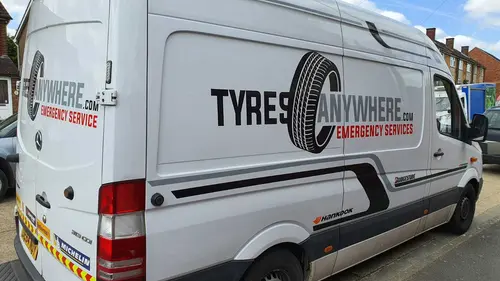
Tyres Anywhere provides breakdown recovery, puncture repair and mobile tyre fitting 24/7 across England and Wales, with more than 100 mobile fitters. We aim to reach you within 60 minutes in most cases and will get your vehicle somewhere safe before working on it. Once you are somewhere safe, call us on 07989 606060.