Can Run-Flat Tyres Be Repaired?
Whether a punctured run-flat can be fixed, how far you can drive on one, and what to do when it needs replacing.
Posted on
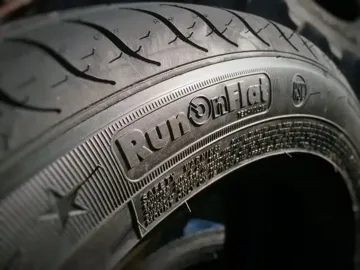
Run-flat tyres are designed so that a puncture doesn’t leave you stranded. Their stiffened sidewalls hold the car up even with little or no air inside, so you can keep driving to somewhere safe instead of stopping at the roadside. That is a real advantage, but it raises an obvious question once the warning light comes on: can the tyre be repaired, or do you need a new one?
The honest answer is that it depends on the tyre manufacturer, the damage and, above all, how the tyre has been driven since the puncture.
Short answer: Sometimes, but often not. Many manufacturers advise against repairing run-flat tyres, and those that allow it set strict conditions: the puncture must be within the normal repairable area of the tread, and the tyre must not have been driven while deflated. In practice, most run-flats have been driven on after a puncture, which is what they are designed for, so replacement is the usual outcome.
How Run-Flat Tyres Work
A standard tyre relies on air pressure to support the weight of the car. When it deflates, the sidewalls collapse and the wheel rim ends up close to the road. A self-supporting run-flat has much thicker, reinforced sidewalls that can carry the load on their own for a limited distance. You will see markings such as RFT, ROF, SSR, ZP or DSST on the sidewall, depending on the brand, or the run-flat symbol shown in your handbook.
Because the car still drives fairly normally with a deflated run-flat, you might not feel the puncture at all. That is why cars with run-flats need a tyre pressure monitoring system (TPMS) to warn you. If you want the wider picture, read run-flat tyres: pros and cons.
How Far Can You Drive on a Punctured Run-Flat?
The figure most often quoted is about 50 miles at up to 50 mph, but this is not universal. The real limit depends on the tyre, the car, how heavily it is loaded and the conditions. Some manufacturers give different distances, so check your vehicle handbook for the figure that applies to you.
Treat that distance as a way to get home, to a safe place or to a fitter, not as permission to finish a long journey. Drive smoothly, avoid hard cornering and braking, and keep well within the speed limit given.
Why Repairs Are Often Ruled Out
When a run-flat is driven while deflated, its sidewalls flex far more than they were built to in normal use. They heat up, and the rubber and internal structure can break down. Crucially, this damage is often on the inside of the tyre and may not be visible from the outside at all. A tyre that looks fine on the car could be weakened in a way that only shows once it is removed and examined, if then.
For a standard tyre, the British Standard for repairs, BS AU 159, already rules out repairs to any tyre that has been run flat or has internal damage. With a run-flat, the whole point is that you can drive on it deflated, so most punctured run-flats fail that test by the time they reach a fitter.
When a Repair May Be Possible
Some tyre manufacturers do permit repairs to their run-flats under specific conditions, while others, and some vehicle makers, say they should never be repaired. Where a repair is allowed, the conditions usually include:
- No driving while deflated: the puncture was caught early, for example a nail found while the tyre was still holding pressure, and the tyre has not been run at low or zero pressure.
- Damage in the repairable area: the hole is within the central three-quarters of the tread and no larger than the size the standard allows, which is 6 mm for car tyres.
- A full internal inspection: the tyre is removed from the wheel and checked inside for any sign of heat or flex damage.
- The manufacturer’s own rules: some limit the number of repairs or apply other restrictions.
If you are unsure what your tyre manufacturer allows, a fitter can check the brand and model and advise. If there is any doubt, replacement is the safer choice. Our guide on repairing a tyre with a nail or screw in it covers the general rules for standard tyres.
What About Tyre Sealant?
Cars with run-flats rarely come with a sealant kit, because the tyre itself is the backup. Using sealant in a run-flat is generally not recommended and can make inspecting or repairing the tyre harder. Leave it to a fitter.
Replacing a Run-Flat Tyre
If your run-flat can’t be repaired, there are a few things to keep in mind when replacing it:
- Don’t mix types on the same axle: run-flats and standard tyres behave differently, so never fit one of each on the same axle. Many manufacturers recommend run-flats on all four wheels if the car was supplied with them.
- Remember there is probably no spare: most cars with run-flats have no spare wheel or jack. If you switch to standard tyres, you will need another plan for punctures, such as a spare, a sealant kit or relying on roadside help.
- Match the size and ratings: the replacement should match the size, load index and speed rating specified for your car.
- Check the TPMS: the pressure sensors need to work correctly with the new tyre, and the system may need resetting afterwards.
Reducing the Chance of a Write-Off
The best way to keep a run-flat repairable is to deal with problems before the tyre goes down. Check your pressures regularly, look over the tread for nails, screws and cuts, and act quickly if the TPMS warns of a slow loss of pressure. Our post on slow puncture signs explains what to look out for, and how to check if my tyre is repairable covers the repair limits in more detail.
If the warning comes on while you are on a fast road, read flat tyre on the motorway: what to do. Even with run-flats, you should leave the motorway and get the tyre checked rather than carrying on as normal.
We Come to You
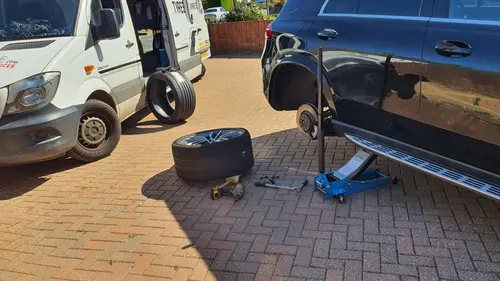
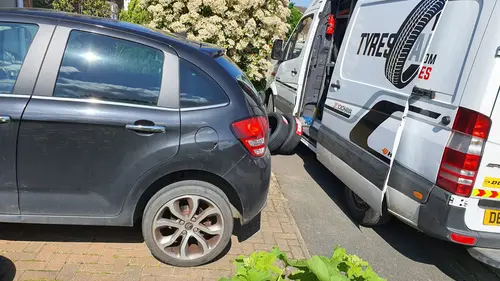
If you have a punctured run-flat, our mobile fitters can come to your home, workplace or a safe roadside location to inspect it, carry out a puncture repair where that is safe and permitted, or replace it through our mobile tyre fitting service. New tyres come with the manufacturer’s guarantee, free wheel balancing and old tyre disposal. See how our prices work, or call 07989 606060, 24/7 across England and Wales.