Part-Worn Tyres: Are They Legal and Safe?
What UK law requires of a part-worn tyre, the risks of buying second-hand, and when a new budget tyre is the better buy.
Posted on
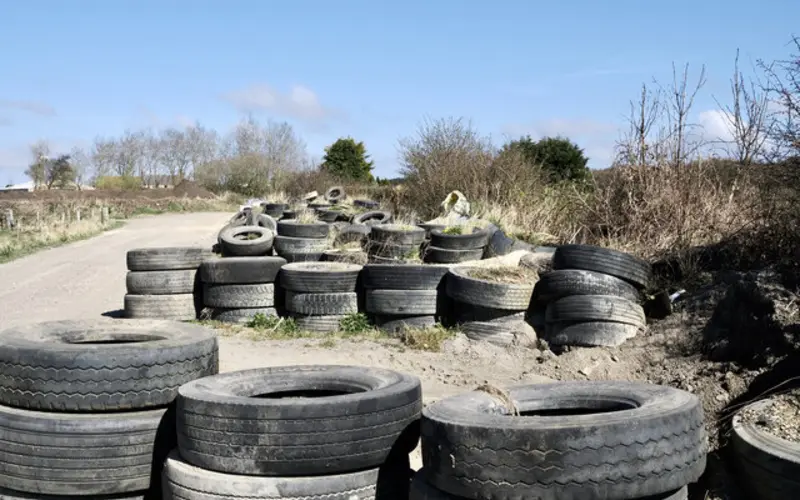
Part-worn tyres are used tyres taken off one vehicle and sold to fit on another. They are widely available in the UK, and when money is tight the low upfront price can look like an easy win.
Buying one is legal, but only if the tyre meets specific conditions, and many on sale do not. Here is what the law says, what to check, and how to decide whether a part-worn tyre really saves you anything.
Short answer: Part-worn tyres are legal to sell and fit in the UK if they meet the Motor Vehicle Tyres (Safety) Regulations 1994. Among other things, the tyre must:
- have at least 2 mm of original tread across its full width and all the way round;
- be permanently marked “PART-WORN” in capital letters at least 4 mm high;
- be free of serious cuts, bulges, exposed cords and unrepaired punctures, and have passed an inflation test.
A legal part-worn tyre can still be a poor choice. Its history is unknown and it has far less tread to use than a new tyre.
What the Law Says About Part-Worn Tyres
The rules on selling part-worn tyres are in the Motor Vehicle Tyres (Safety) Regulations 1994, often referred to as the part-worn tyre regulations. They put the responsibility on the seller, and Trading Standards enforce them. In summary, a part-worn car tyre offered for sale must:
- Have at least 2 mm of tread: in the original grooves, across the full breadth of the tread and around the entire circumference. Note that this is stricter than the 1.6 mm legal limit for tyres in use.
- Be marked PART-WORN: permanently and legibly, in upper-case letters at least 4 mm high, next to the tyre’s approval marking. The marking must not be applied by hot branding or cutting into the tyre.
- Be free of serious structural damage: no cuts on the outside longer than 25 mm or 10% of the section width (whichever is greater) that are deep enough to reach the ply or cord, no internal or external bulges or tears, and no exposed ply or cord.
- Have any puncture properly repaired: to the British Standard, BS AU 159, and not have unrepaired penetration damage.
- Have passed an inflation test: before sale, so that any hidden weakness shows up.
Once fitted, the tyre has to meet the same rules as any other tyre on the road, including at least 1.6 mm of tread across the central three-quarters. Our guide to the UK tread depth law explains those rules and the penalties.
Are Part-Worn Tyres Safe?
A properly inspected part-worn tyre with healthy tread can be roadworthy. The trouble is that you usually cannot know what it has been through. A used tyre may have:
- been driven while flat or badly under-inflated, which damages the inner sidewall in ways that are hard to see from outside;
- hit potholes or kerbs hard enough to weaken the structure without leaving an obvious bulge yet;
- had a repair that was not carried out to the British Standard, or one in a position where repairs are not allowed;
- been sitting in a yard for a long time, exposed to sun and weather;
- come off an accident-damaged or written-off vehicle.
Investigations by Trading Standards and the tyre safety charity TyreSafe have repeatedly found part-worn tyres on sale without the required marking, and some with dangerous damage. That does not mean every seller cuts corners, but it does mean you cannot assume a tyre has been checked just because it is on sale.
How to Check a Part-Worn Tyre Before You Buy
If you do decide to buy part-worn, look at the tyre yourself before it goes on the car:
- find the PART-WORN marking; if it is missing, the tyre should not be on sale;
- measure the tread in several places around the tyre and across its width; it should be at least 2 mm everywhere, and ideally much more;
- check the DOT date code to see how old it is; our guide to reading the DOT date code shows how;
- look at both sidewalls and inside the tyre for cracks, bulges, cuts, patches and rubber dust or creasing on the inner liner;
- check that the size, load index and speed rating match what your car needs;
- make sure the tyre is the same type and pattern as the other tyre on the same axle, or close to it.
Our list of signs a tyre needs replacing is a useful checklist for spotting faults.
Do Part-Worn Tyres Actually Save Money?
The price on the tyre is only part of the story. What you are really paying for is usable tread: the rubber between what is there now and the 1.6 mm legal limit.
A new car tyre typically starts with around 7 to 8 mm of tread. A part-worn tyre may have 3 or 4 mm, and the law only requires 2 mm. A part-worn with 3 mm leaves you less than 1.5 mm to use before it is illegal, compared with roughly 6 mm on a new tyre. So the part-worn would have to cost around a quarter of the new price or less just to work out the same per millimetre, before you count the cost of fitting it again sooner. Grip in the wet also drops as tread wears, so you spend more of a part-worn tyre’s short life in the zone where it performs worst.
When a New Budget Tyre Makes More Sense
For most drivers, a new budget tyre is a better buy than a part-worn one. A new tyre comes with its full tread depth, a known history and the manufacturer’s guarantee. It also has to meet the same legal approval standards as premium tyres, and carries a tyre label showing its wet grip and fuel efficiency ratings, which you can compare before you buy. Our guide to tyre ratings explains the label.
A part-worn might be worth considering only as a short-term stopgap, for example on a car you are about to sell or scrap, and only from a reputable seller who can show the tyre meets the regulations. Even then, compare it against a new budget option first. If you want an idea of what affects the total cost, see how much mobile tyre fitting costs.
Getting New Tyres Fitted
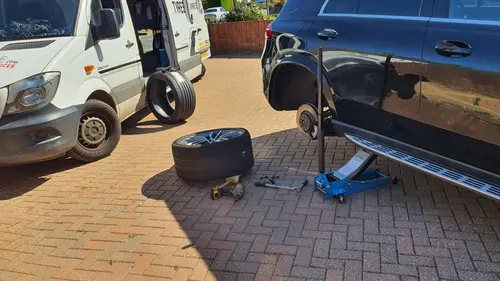
We fit new premium, mid-range and budget tyres at your home, workplace or the roadside through our mobile tyre fitting service. New tyres carry the manufacturer’s guarantee, and every fitting includes free wheel balancing and free disposal of your old tyres. Our prices are competitive with no hidden fees; see mobile tyre fitting prices for what affects a quote.
Call 07989 606060 at any hour, or send your postcode and tyre size on WhatsApp for a quote. We work 24/7 across England and Wales.