Summer, Winter or All-Season Tyres: Which Do You Need in the UK?
How the three tyre types differ, what the 3PMSF and M+S markings mean, and how to choose for British weather and your budget.
Posted on

Most cars in the UK leave the factory on summer tyres, and most drivers never change that. As the evenings draw in, though, plenty of people start wondering whether winter or all-season tyres would be safer, and whether they are worth the money in a country where heavy snow is the exception rather than the rule.
The right choice depends on where you live, how you drive and how much hassle you are willing to put up with. This guide sets out the differences plainly so you can decide.
Short answer: For most UK drivers:
- summer tyres are fine if you live in a mild, low-lying area and can avoid driving in snow;
- all-season tyres with the 3PMSF (mountain and snowflake) symbol are a sensible single set for mixed British weather;
- dedicated winter tyres make sense if you live on high ground, in rural areas or in places where snow and ice are regular, or if you cannot avoid driving in them.
Winter tyres are not a legal requirement in the UK, but some European countries require them in certain conditions.
What Is the 7°C Rule?
You will often hear that 7°C is the point where summer tyres start to lose their advantage. It is a rule of thumb used across the tyre industry rather than an exact scientific line, but the idea behind it is sound. The rubber compound in a summer tyre is designed to stay firm and grippy in warm conditions. As the temperature drops, that compound stiffens, and a stiffer tyre grips less well on cold, wet roads.
Winter tyres use a softer compound that stays flexible in the cold, plus a tread pattern with many more small slits, called sipes, that bite into slush and snow. Above roughly 7°C, the soft compound works against them: they wear faster and generally brake and corner less sharply than summer tyres on warm, dry roads.
In much of the UK, average daytime temperatures sit below 7°C for a good part of the winter, which is why the question is worth asking even where snow is rare.
Summer, Winter and All-Season Tyres Compared
| Type | Best at | Weaker at |
|---|---|---|
| Summer | Dry and wet roads in mild and warm weather; sharp handling and short braking distances | Cold, icy or snowy roads; grip falls away in low temperatures |
| Winter | Cold, wet roads, slush, snow and ice | Warm weather; faster wear and less precise handling in summer |
| All-season | A reasonable all-year compromise for temperate climates like the UK’s | Not as strong as a summer tyre in heat or a winter tyre in deep snow |
Modern all-season tyres (sometimes sold as all-weather tyres) have improved a lot. Many carry the same snow certification as winter tyres while performing acceptably through a British summer. They are a compromise, so do not expect the ultimate dry grip of a sporty summer tyre or the deep-snow traction of a dedicated winter tyre.
3PMSF vs M+S: What Do the Markings Mean?
Two markings on the sidewall cause most of the confusion when choosing cold-weather tyres.
- M+S (mud and snow): a marking the manufacturer applies itself. There is no standard test behind it, so it tells you the tread is designed with mud and snow in mind, not that the tyre has proven grip in the cold. Some summer-biased SUV tyres carry M+S.
- 3PMSF (three-peak mountain snowflake): a symbol of a mountain with three peaks and a snowflake inside. A tyre can only carry it after passing a standardised snow traction test. Winter tyres carry it, and so do many all-season tyres.
If you want genuine cold-weather performance, look for the 3PMSF symbol rather than relying on M+S alone. Tyres with 3PMSF usually carry M+S as well, but M+S on its own is no guarantee. If you plan to drive in Europe in winter, check the rules for each country you will pass through, because some specify winter or 3PMSF-marked tyres in certain conditions or periods.
Do You Need Winter Tyres in the UK?
There is no UK law requiring winter tyres, and for many drivers in towns and cities in the south and Midlands, good summer tyres with plenty of tread do the job for most of the year. The case for changing gets stronger if:
- you live on high ground, in northern England, in Wales or in rural areas where roads are gritted late or not at all;
- you have to drive early in the morning or late at night, when roads are coldest;
- you cannot simply stay at home when it snows, for example if you are a carer, key worker or shift worker;
- your car is rear-wheel drive or powerful, and struggles for traction in the cold.
Whatever you fit, cold-weather tyres do not change the laws of physics. The Highway Code advises leaving up to ten times the normal gap on icy roads and driving gently in snow. Better tyres shorten stopping distances in the cold; they do not remove the risk.
Two Sets or One All-Season Set: Which Costs Less?
Running separate summer and winter tyres sounds expensive, but the cost is not simply doubled. While one set is on the car, the other is not wearing out, so each set lasts more calendar years. The extra costs are:
- buying the second set in the first place (some drivers buy a second set of wheels too, which makes swaps quicker);
- paying for the changeover twice a year, usually around October and again around March or April;
- somewhere clean, dry and cool to store the tyres you are not using.
An all-season set avoids the storage and the twice-yearly swap. For drivers who want better winter grip than summer tyres give, but do not want to run two sets, that convenience is often the deciding factor. Whatever you choose, fit the same type on all four wheels. Mixing winter tyres on one axle with summer tyres on the other can upset the balance of the car under braking and cornering.
Size, load index and speed rating still need to suit your car. Winter tyres are sometimes allowed a lower speed rating than standard, but check your handbook first. Our guides to choosing the right tyres and speed ratings explain the markings.
Tread Depth Matters More in Winter
The legal minimum in the UK is 1.6 mm across the central three-quarters of the tread, all the way round. That is the point at which a tyre becomes illegal, not the point at which it stops being safe. Wet and slushy roads are where worn tyres struggle most, because shallow grooves cannot clear water quickly enough. A winter tyre with little tread left loses much of its advantage in snow, too. Our article on the UK tread depth law shows how to check yours, and how seasons affect tyre performance covers pressures in cold weather.
Getting the Right Tyres Fitted
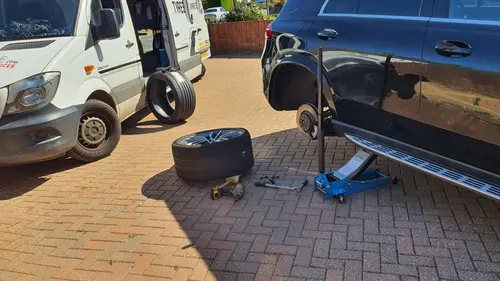
If you have decided to switch to winter or all-season tyres, or your summer tyres are simply due for replacement before the cold sets in, our mobile tyre fitting service brings the tyres to your home or workplace. We stock premium, mid-range and budget options, and every fitting includes free wheel balancing and free disposal of your old tyres. You can browse the makes we supply on our tyre brands page.
Call 07989 606060 at any time, day or night, or send your postcode and tyre size on WhatsApp. The size is the sequence on the sidewall that looks like 205/55 R16. We cover England and Wales, 24 hours a day.