Van Tyres Explained: C Markings, Load Index and Pressures
How to read a van tyre, choose the right replacement and keep it in good shape under load.
Posted on
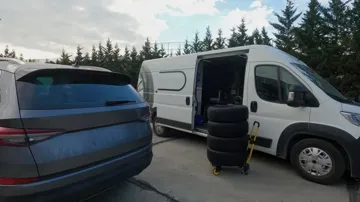
A van tyre can look almost identical to a car tyre of the same size, but it is built for a very different job. It has to carry a heavy payload day after day, often on short, stop-start routes, and it is usually run at higher pressures. Fitting the wrong type, or running the right type at the wrong pressure, is one of the most common causes of early wear and tyre failure on working vans.
Here is how to read the markings on a van tyre, what the numbers mean for your load, and how to look after your tyres so they last.
Short answer: a C after the rim size, as in 215/65 R16C, means the tyre has a commercial (reinforced) construction for vans. The two load numbers that follow, such as 109/107, give the load index for single-wheel and twin-wheel use. Always fit a tyre with a load index at least as high as your van requires, and inflate it to the pressures on your van’s plate or in the handbook, which are often higher when the van is loaded.
What Does the C on a Van Tyre Mean?
The C stands for commercial. A C-marked tyre has a stronger carcass than a passenger car tyre, designed to carry heavier loads at higher pressures. You will find it straight after the rim diameter, for example 195/75 R16C or 225/65 R16C.
Do not confuse it with XL (extra load). An XL tyre is a reinforced passenger car tyre; it carries more than a standard car tyre but is generally not a substitute for a C tyre where the van manufacturer specifies one. Our guide on what XL means on a tyre explains that marking in more detail.
Reading a Full Van Tyre Size
Take 215/65 R16C 109/107T as an example:
- 215: tyre width in millimetres.
- 65: sidewall height as a percentage of the width.
- R: radial construction.
- 16: fits a 16-inch rim.
- C: commercial construction.
- 109/107: load index for single and twin (dual) wheel fitment.
- T: speed rating, here up to 118 mph.
For a wider look at sidewall codes, see tyre ratings explained.
Why Van Tyres Have Two Load Numbers
Many vans and light trucks can be built with twin rear wheels, where two tyres sit side by side on each end of the axle. Each tyre in a twin pair carries slightly less than a tyre on its own, so the sidewall gives two figures. The first is the maximum load per tyre when fitted singly; the second is the maximum per tyre in a twin arrangement.
| Load index | Maximum load per tyre |
|---|---|
| 104 | 900 kg |
| 107 | 975 kg |
| 109 | 1,030 kg |
| 112 | 1,120 kg |
| 115 | 1,215 kg |
So a 109/107 tyre can carry up to 1,030 kg fitted singly, or up to 975 kg per tyre when twinned. On most panel vans with single rear wheels, the first number is the one that matters.
Matching the Load Index to Your Van
Your replacement tyres must have a load index at least equal to the figure your van’s manufacturer specifies. You can find this in the handbook, on the tyre information plate (often in the door frame), or by checking the tyres the van came with. Fitting a lower load index to save money is a false economy: the tyre may overheat under a full load, and it can cause problems with insurance and at the MOT.
A higher load index is generally fine, as long as the size and speed rating are also correct. If you are unsure, give your fitter the registration and they can check what the van needs.
Van Tyre Pressures: Why They Matter More
Van tyres usually run at noticeably higher pressures than car tyres, and many manufacturers give a separate, higher figure for the rear tyres when the van is fully loaded. Use the figures on your van’s plate or in the handbook rather than the maximum moulded on the sidewall, which is a limit, not a target.
Under-inflation is particularly harmful on a loaded van. The sidewalls flex more, which builds heat, and heat is what breaks down a tyre’s structure. Over time this can lead to sudden failure, especially on long motorway runs in warm weather. Low pressure also increases fuel use and wears the shoulders of the tread. Our article on how under-inflated tyres affect your vehicle covers this in more depth.
For a working van, check pressures at least once a week, with the tyres cold, and adjust them when your load changes significantly. If you need a refresher, see how to put air in tyres.
Overloading: The Hidden Tyre Killer
Every van has a maximum gross vehicle weight and maximum axle weights. Carrying more than this puts the tyres beyond what they were designed for, even if they are the correct type. The signs of a van that is regularly overloaded include tyres that run hot, cracking or bulges in the sidewall, and rapid shoulder wear. If you carry heavy tools or materials, it is worth weighing the van fully loaded at least once.
How Van Tyres Wear
Van tyres often wear faster than car tyres, and unevenly. The tyres on the driven axle take the most punishment, particularly on front-wheel drive vans that also do the steering. Kerbing during deliveries, frequent tight turns and heavy braking all add up.
- Check tread depth regularly: the legal minimum for vans up to 3.5 tonnes is the same as for cars, 1.6 mm. Our guide to the UK tread depth law explains how to measure it.
- Look for uneven wear: wear on one edge usually points to alignment problems. See what can cause uneven tyre wear.
- Inspect the sidewalls: cuts and bulges from kerbs are common on vans and mean the tyre needs replacing.
- Watch for slow pressure loss: a tyre that needs topping up every few days may have a slow puncture.
Can a Van Tyre Be Repaired?
Often, yes. A puncture from a nail or screw in the central part of the tread can usually be repaired to the same standards as a car tyre, provided the tyre has not been driven on flat and there is no other damage. Damage to the shoulder or sidewall means replacement. Our mobile tyre repair service can assess it on site.
Keeping Your Van on the Road
For a business, the cost of a tyre is usually small compared with the cost of a van sitting idle. Weekly checks, correct pressures and the right load index go a long way towards avoiding unplanned downtime.
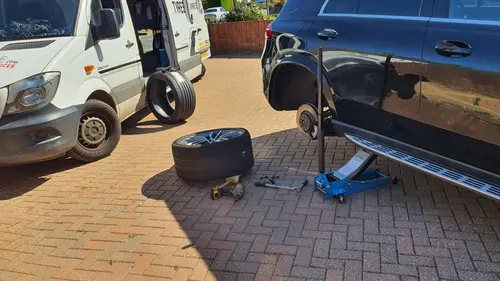
When a tyre does need replacing, our van mobile tyre fitting service comes to your yard, site or the roadside, 24/7 across England and Wales, with free balancing and disposal of the old tyre. You can see how our prices work or call us on 07989 606060.