TPMS Sensor Faults: Why the Warning Light Stays On and What to Do
When your tyres are at the right pressure but the light won’t go out, the problem is usually the monitoring system itself. Here is how to work out what is wrong.
Posted on

You have checked all four tyres, set them to the right pressure, and the tyre pressure warning light is still on. Or it flashes every time you start the car and then stays lit. This is a common situation, and in most cases it points to a fault with the tyre pressure monitoring system (TPMS) rather than a problem with the tyres.
If the light has only just come on, start with our guide to the tyre pressure warning light, which covers what it means and how to check your pressures. This article picks up where that one leaves off: what to do when the pressures are fine but the warning won’t go away.
Short answer: If the pressures are correct and the light stays on or flashes, the most likely causes are:
- a sensor whose internal battery has run out (common after several years);
- a sensor damaged by corrosion, an impact or a tyre change;
- a wheel fitted without a sensor, or a new sensor that hasn’t been programmed to the car;
- an indirect system that needs resetting after the pressures were adjusted.
A faulty sensor is replaced and programmed to the car. On cars first used from 1 January 2012 that have TPMS, a warning light that stays on is an MOT failure.
Direct or Indirect: Which System Do You Have?
The answer decides what can go wrong.
| Direct TPMS | Indirect TPMS | |
|---|---|---|
| How it works | A battery-powered sensor in each wheel measures pressure and transmits it | Uses the ABS wheel-speed sensors to spot a tyre turning faster than the others |
| Clues you have it | Individual pressures shown on the dashboard; a metal or rubber valve with a sensor behind it | A reset button or menu option; no individual readings |
| Typical faults | Flat sensor battery, corroded or broken valve, unprogrammed sensor | Not reset after inflating, mismatched tyres, ABS sensor fault |
If you are not sure, your handbook will say, and a fitter can tell by looking at the valves or with a TPMS tool.
What Does a Flashing TPMS Light Mean?
On many cars, a tyre pressure light that flashes for around a minute after you start the engine and then stays on means the system has detected a fault, rather than low pressure. Typical triggers are a sensor that has stopped transmitting, a wheel the car can’t identify, or a system error. A light that comes on steadily, without flashing, usually means low pressure. Behaviour varies between manufacturers, so check the warning lights section of your handbook.
Either way, check the pressures first with a gauge. A fault light doesn’t rule out a genuine puncture as well.
How Long Do TPMS Sensors Last?
Direct TPMS sensors run on a small sealed battery. Sensor makers generally quote a life of roughly five to ten years, depending on how often the sensor transmits and how the car is used. The battery normally can’t be replaced on its own, so when it runs down, the whole sensor is replaced.
Because the sensors on a car are usually the same age, once one fails the others may not be far behind. Some drivers choose to replace all four at the same time, particularly if the tyres are coming off anyway, to save repeated work later. A fitter with a TPMS tool can often read the condition of each sensor before you decide.
Valve Damage and Corrosion
On most direct systems the sensor is attached to the valve. Many use a metal valve stem, which is exposed to water, road salt and grit all year. Corrosion can seize the valve nut or core, cause slow air leaks, or break the stem when it is disturbed. Sensors can also be damaged by a hard kerb strike, a pothole, or careless fitting when a tyre is changed.
A few habits help:
- use plastic valve caps rather than decorative metal ones, which can corrode onto a metal stem;
- tell your fitter the car has TPMS before a tyre change, so they can take care around the sensor;
- replace the valve seals and parts when a tyre is fitted, as the manufacturer recommends, since some parts are designed to be used only once;
- don’t use tyre sealant unless you have to, as some sealants can clog sensors.
If one tyre keeps losing air slowly and there is no puncture in the tread, a leaking valve is a likely culprit. Our guide to slow punctures covers the other causes.
Resetting and Relearning the System
“Reset” and “relearn” mean different things.
- Reset (mostly indirect systems): after setting all four tyres to the correct pressure, you tell the car to take the current state as normal, using a button or the infotainment menu. Only do this with the pressures correct, or the system will learn the wrong baseline.
- Relearn (direct systems): when a sensor is replaced or wheels are swapped, the car has to learn the new sensor’s ID and position. Some cars do this automatically after a short drive; others need a diagnostic or TPMS tool.
Swapping to a second set of wheels, such as winter wheels, is a common trigger. If the extra set has no sensors, or sensors the car hasn’t learned, the light will stay on. Replacement sensors are either made for the car or are programmable units that have to be set up for it before they will work.
Will a TPMS Fault Fail the MOT?
Yes, on cars first used from 1 January 2012 that are fitted with TPMS. If the warning light is on, or the system is clearly not working, it is a fail. Getting a faulty sensor sorted before the test saves a retest. The DVSA MOT inspection manual sets out the details, and your tester can explain what they found.
It is also a safety point. A car whose warning light is permanently on can’t warn you about a real puncture, and that matters most on cars with run-flat tyres, where the light may be the only sign a tyre is empty. See can run-flat tyres be repaired? for more.
What to Do Next
- Check and set all four tyres to the pressures in the handbook or on the door-frame sticker.
- If you have an indirect system, carry out the reset as the handbook describes.
- Drive for a while. Some systems take several miles to clear.
- If the light stays on, flashes, or one tyre keeps losing air, have the sensors and valves checked.
Meanwhile, check your pressures by hand regularly, because the system can’t be relied on to warn you. Our guide on how to put air in tyres explains how.
Getting Help
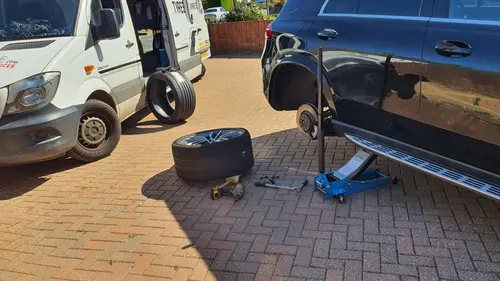
If a leaking valve or a puncture is behind the warning, our fitters can come to your home, workplace or the roadside, 24/7 across England and Wales, for a puncture repair where it is safe, or a new tyre through our mobile tyre fitting service. Call 07989 606060, or send your postcode and tyre size on WhatsApp and tell us your car has TPMS.