Caravan and Trailer Tyre Safety
Why caravan and trailer tyres usually age out before they wear out, how to check them before a trip, and what to do if one fails while you are towing.
Posted on
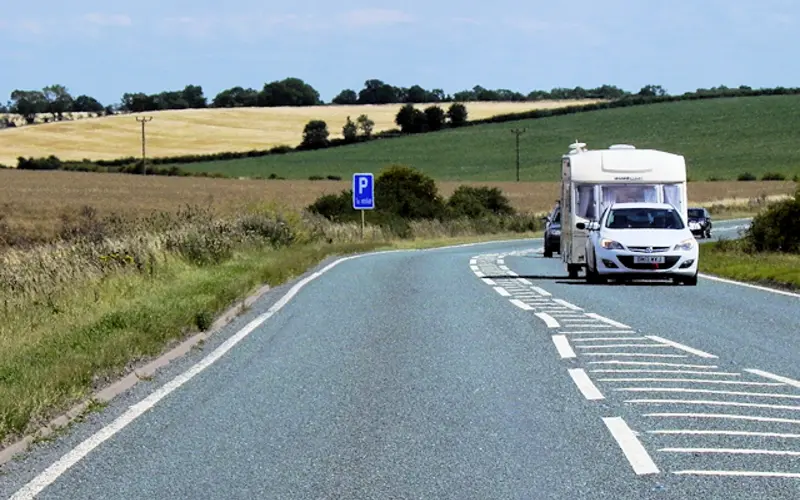
Caravan and trailer tyres have a hard life, even though they rarely cover many miles. They spend months standing still, often in the sun, and are then asked to carry a heavy load at motorway speeds. A tyre that still has plenty of tread can be weakened inside by age.
A tyre failure on a caravan is also more serious than on a car, because it can make the whole outfit unstable. A few checks before each trip, and replacing tyres on age rather than tread, go a long way.
Short answer: To keep caravan and trailer tyres safe:
- replace them on age, commonly advised at around five years from manufacture, whatever the tread looks like;
- check for cracking, bulges and flat spots after the van has been standing;
- inflate to the pressure in the caravan or trailer handbook for its laden weight, and check when cold;
- fit tyres with at least the load index the manufacturer specifies;
- if a tyre fails while towing, hold the wheel steady, ease off gently and pull over somewhere safe.
How Old Should Caravan Tyres Be Before You Replace Them?
There is no legal age limit for caravan tyres in the UK, but the long-standing advice from caravanning organisations is to replace them at around five years old, regardless of tread depth, and never to use tyres more than seven years old. Caravans and trailers cover so few miles that the tread rarely wears out first. Instead the rubber ages, dries and loses strength, inside and out.
Age is counted from the date the tyre was made, not when it was fitted. To find it, look for the DOT code on the sidewall and the four-digit number at the end. The first two digits are the week and the last two are the year, so 2321 means the 23rd week of 2021. If you buy a used caravan, check this before your first trip, as the tyres may be older than the van’s paperwork suggests.
Cracking and Flat Spots From Standing
Sunlight and ozone attack rubber, and a caravan that is parked for the winter has the same patch of each tyre pressed against the ground for months. Look for:
- Fine cracks in the sidewall or between the tread blocks, which get worse over time. Deeper cracks mean the tyre should be replaced.
- Bulges or lumps on the sidewall, which point to internal damage. Don’t tow on a tyre with a bulge.
- Flat spots that cause a thumping or vibration once you set off.
You can reduce the damage in storage by using tyre covers to keep the sun off, moving the van a little every so often so the tyres rest on a different spot, keeping them at the correct pressure, and using wheel stands or a level, clean surface where you can.
Pressures and Load Index for a Laden Caravan or Trailer
Caravan tyres often run at higher pressures than you might expect, and the right figure depends on the tyre and the weight it carries. Use the pressure in the caravan or trailer handbook or on the plate on the chassis, not the figure for your car. Check them when the tyres are cold, before you set off, and use a gauge that reads high enough.
Under-inflation is a major cause of caravan tyre failures. A soft tyre flexes more and heats up on a long run, and the damage may not show until it gives way. Our guide on how under-inflated tyres affect your vehicle explains why.
When replacing tyres, the load index must be at least what the manufacturer specifies. Some caravans and trailers need commercial (C) or reinforced tyres; an ordinary car tyre of the same size may not be strong enough. Our guide to van tyres and load ratings covers C markings and load index tables. And don’t overload: the tyres can only cope with the weight they are rated for, and nose weight and payload limits matter for stability too.
Checking Caravan and Trailer Tyres Before a Trip
- Check the DOT date on every tyre, including the spare.
- Look over each sidewall for cracks, bulges and cuts, turning the wheel to see all of it.
- Check the tread depth; for a caravan or light trailer the legal minimum is 1.6 mm across the central three-quarters, as on a car.
- Set the pressures cold to the handbook figures for the load.
- Check the wheel nuts or bolts are tightened to the manufacturer’s torque setting.
- Check the car’s tyres too, using the higher pressures for towing or a full load given in the car’s handbook.
- Make sure the spare is inflated and you have the tools to fit it, including any locking wheel nut key.
Our guide to tyre checks before a long journey covers the towing car in more detail.
What to Do If a Tyre Fails While Towing
A blowout on a caravan or trailer can make it sway or snake. The natural reaction is to brake hard, but that can make things worse. Instead:
- hold the steering wheel firmly and keep it as straight as you can, without fighting the sway;
- ease off the accelerator gently and let the outfit slow down;
- brake gently only once the sway has settled and you are in control;
- signal and pull over somewhere safe, ideally off the main carriageway.
Changing a caravan wheel is harder than changing a car’s, and it should never be done on a motorway hard shoulder. Get everyone away from the traffic, behind the barrier if there is one, and call for help. Our guide on a flat tyre on the motorway explains where to stop and what to do. On an ordinary road, only change the wheel yourself if you are well away from traffic, on firm level ground, and have the correct jack and tools for the caravan.
Keeping to the towing speed limits, which are lower than for solo cars at 50 mph on single carriageways and 60 mph on dual carriageways and motorways, also reduces the strain on the tyres. Remember that you must not use the right-hand lane of a motorway with three or more lanes while towing.
Getting Help
If the car towing your caravan or trailer has a flat or damaged tyre, our mobile fitters can come to you, 24/7 across England and Wales, through our mobile tyre fitting service. If the outfit needs moving, ask us about breakdown recovery. Call 07989 606060, or send your postcode and tyre size on WhatsApp, and tell us you are towing.