SUV and 4x4 Tyres Explained
HT, AT and MT tyres, load ratings, big wheels and why four-wheel-drive cars need matching tyres all round.
Posted on

SUVs and 4x4s are heavier and taller than ordinary cars, often sit on larger wheels, and in many cases drive all four wheels. All of that affects which tyres they need and how you should replace them.
Most SUVs in the UK spend almost all their time on tarmac, so the right tyre is usually a road tyre built to carry the weight. Here is how to read the options and avoid the mistakes that cost money.
Short answer: SUV and 4x4 tyres fall into three broad types:
- HT (highway terrain): road tyres for SUVs; quiet and comfortable, the right choice for most drivers;
- AT (all-terrain): a compromise for mixed road and off-road use, with a chunkier tread;
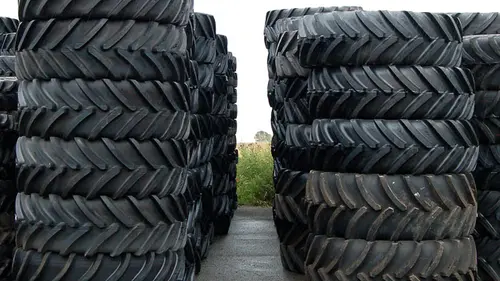
- MT (mud-terrain): for regular serious off-roading; noisier and less grippy on wet roads.
Whatever the type, match or exceed the load index and speed rating your vehicle needs, and on four-wheel-drive cars keep the tread depth similar on all four tyres.
HT, AT or MT: Which Type of 4x4 Tyre Do You Need?
| Type | Best for | Trade-offs |
|---|---|---|
| HT / road SUV tyre | Motorways, town, the school run, towing on tarmac | Limited grip on mud, wet grass or loose ground |
| AT (all-terrain) | Farm tracks, green lanes, gravel, rural driving with regular rough ground | More road noise; road grip and braking usually not as good as a road tyre |
| MT (mud-terrain) | Deep mud, ruts and frequent serious off-road use | Noisy, less grip on wet tarmac, often lower speed ratings |
The open, blocky tread that clears mud off-road leaves less rubber touching the road on tarmac. That is why an aggressive tyre that looks capable can stop and corner less well in the wet. Be honest about where you drive. If you go off-road a few times a year, a road tyre or a road-biased all-terrain is usually the better choice.
You may also see M+S (mud and snow) on the sidewall, which many SUV and all-terrain tyres carry. It is a manufacturer’s marking. The three-peak mountain snowflake symbol shows a tyre has passed a recognised snow test. If you want winter grip, look for that symbol. Our article on how seasons affect tyre performance explains more.
Why Load Index Matters More on an SUV
An SUV can weigh a lot more than a hatchback, and many are used to tow caravans, horseboxes or trailers. Each tyre’s load index, the number before the speed letter in a size such as 235/55 R19 105V, sets the maximum weight it can carry. Fitting a tyre with a lower load index than the vehicle requires risks overheating and failure under a full load.
Many SUV sizes are XL (extra load) tyres for this reason. When replacing them, match or exceed the original load index and speed rating. Our guides to tyre ratings and what XL means on a tyre explain the markings.
Larger Wheels and Low-Profile Tyres
Many modern SUVs come on 19, 20 or 21 inch wheels with relatively low-profile tyres. They look good and can sharpen the handling, but there are trade-offs:
- Less cushion: a shorter sidewall gives less protection against potholes and kerbs, so bulges, cuts and bent rims are more likely.
- Firmer ride and more noise: especially on rough road surfaces.
- Higher cost: larger SUV sizes generally cost more than common car sizes, and some are less widely stocked, so a replacement may need ordering in.
- Manufacturer markings: some SUVs are fitted with tyres approved by the car maker, marked with a code on the sidewall. Matching that marking is worth considering, especially on performance SUVs.
Never change to a different size without checking it is approved for your vehicle. A different overall diameter can upset the speedometer, the stability control and, on four-wheel-drive cars, the drivetrain.
Why 4WD and AWD Cars Need Matching Tyres on All Four Wheels
On a four-wheel-drive or all-wheel-drive car, the front and rear axles are connected through the drivetrain. A new tyre has a slightly larger rolling diameter than a worn one of the same size, so it turns at a different speed. On many systems, the centre differential or coupling has to make up the difference all the time, which builds heat and wear and can lead to expensive repairs.
For that reason, many manufacturers advise:
- fitting the same size, brand and pattern on all four wheels;
- keeping tread depths within a small difference of each other, with the exact tolerance in the handbook;
- replacing tyres in sets of four, or at least as an axle pair if the remaining tyres are close in tread depth;
- rotating tyres regularly, if the handbook allows it, so they wear evenly.
If one tyre is ruined by a puncture early in the life of a set, a single new tyre may be too different from the others. A fitter can measure the tread on the rest and tell you whether replacing one, two or four makes sense. Part-time 4x4 systems are generally less sensitive than permanent all-wheel drive, but the handbook is the authority.
On-Road and Off-Road Tips
- Pressures: use the pressures in the handbook or on the door-frame sticker, including the higher figures for a full load or towing. Some drivers lower pressures for serious off-road work, but always re-inflate before returning to the road.
- Check after rough ground: stones and roots can cut sidewalls. Look for cuts, bulges and embedded objects after an off-road trip.
- Tread depth: the legal minimum is 1.6 mm across the central three-quarters of the tread, as covered in our UK tread depth law guide. Off-road tyres lose much of their grip on mud well before that.
- Watch for uneven wear: heavy vehicles are hard on alignment. See what can cause uneven tyre wear.
Getting SUV Tyres Fitted
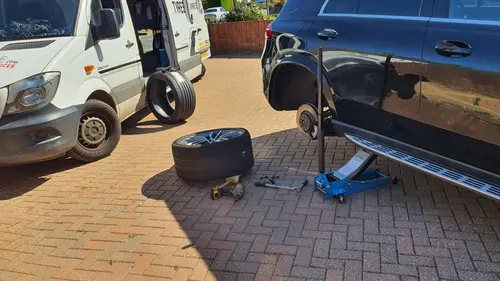
We fit SUV and 4x4 tyres at your home, workplace or the roadside, 24/7 across England and Wales, with premium, mid-range and budget options, free wheel balancing and old tyre disposal. See our mobile tyre fitting service or the tyre brands we fit.
Call 07989 606060, or send your postcode and the full tyre size from the sidewall on WhatsApp. If your car is four-wheel drive, mention it, so we can check the tread on the other tyres.